

The D&D World of Warcraft Death Knight (Class Guide)
As an Amazon Associate I earn from qualifying purchases.

Article Summary
- The Dungeons & Dragons World of Warcraft supplement will be arriving on November 17, 2026
- The supplement introduces the new Death Knight Class, which uses the D&D 5.5E Paladin as a base class and adds unique “Specializations” to capture the feel of the MMORPG mechanics.
- There are three specializations for the Death Knight: Blood, Frost and Unholy, each of which layers in unique abilities.
- The Death Knight is a new Hero Class that starts at Level 3 and accesses the Oath of the Ebon Blade subclass.
After months of waiting, the world of Azeroth is officially about to become a part of the Dungeons & Dragons multiverse, with Wizards of the Coast preparing to roll out the new D&D World of Warcraft crossover.
In addition to new lore, rules, species, magic items and monsters, the book also includes 13 new classes that blend classic WoW builds with the D&D 5.5E ruleset. One of those options is the Death Knight, an iconic playable option from Blizzard’s MMORPG that is now being brought to the tabletop.
So are these undead warriors worth playing? Below, we face down the Scourge and uncover all the details.

What is a Death Knight in Warcraft lore?
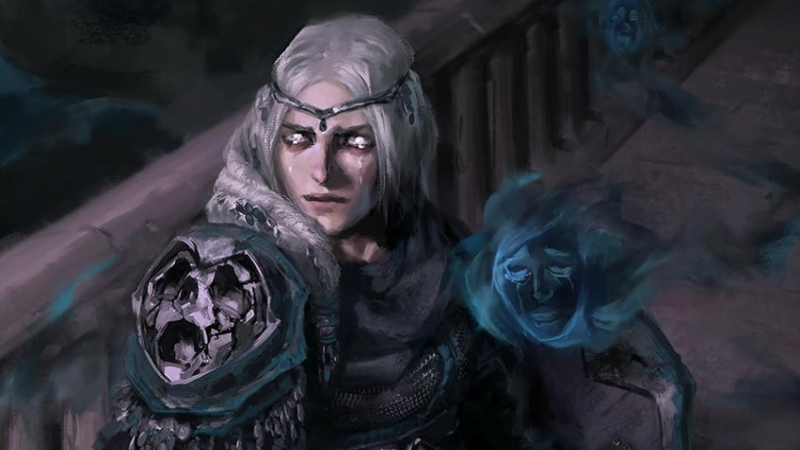
In Warcraft lore, Death Knights are powerful undead warriors who were originally created to serve as the immortal lieutenants of the Lich King Ner’zhul. The most famous of these dreaded warriors was Arthas Menethil, a noble Paladin and crown prince of the kingdom of Lordaeron who eventually took on the mantle of Lich King after being corrupted by a cursed blade known as Frostmourne.
Operating out of the frozen undead-haunted wasteland of Northrend, a company of Death Knights was freed from the Lich King’s control and became the Knights of the Ebon Blade under the command of Highlord Darion Mograine. These rogue Death Knights dedicated themselves to overthrowing the Lich King and protecting the lands of Azeroth. Eventually, a Paladin named Bolvar Fordragon became the Lich King, but was able to resist the title’s evil, soul warping powers, creating a new group of benevolent Death Knights known as The Four Horsemen to serve and expand the ranks of the Ebon Blade and stop the spread of the undead force known as the Scourge.
In battle, Death Knights prefer to engage their foes up close with melee weapons suffused with unholy magic. They also tend to drag their foes into one-on-one combat and wield their magic to draw attacks and prevent enemies from fleeing their grasp.

How does the Death Knight Class work in the D&D 5.5E rules?
There are a few important things to note about the Death Knight in the context of the official 2024 D&D rules.
- The Death Knight is not a new D&D 5.5E Class: While the Death Knight is listed as a “class” in the D&D World of Warcraft supplement, this is a bit misleading and confusing. In fact, it’s not a class in the same sense as the 13 official D&D 5.5E options of Artificer, Barbarian, Bard, Cleric, Druid, Fighter, Monk, Paladin, Ranger, Rogue, Sorcerer, Warlock and Wizard. Instead, the Death Knight uses the existing 5.5E Paladin class as a base and then modifies it through Specializations, which offer unique mechanical benefits designed to replicate features found in the MMORPG. In the case of the Death Knight, there are three Specializations to choose from: Blood, Frost and Unholy.
- The Death Knight is a Hero Class: This is a new option introduced in the D&D WoW supplement. Hero classes are specifically designed to start at Level 3 or higher, which means they automatically get their subclass as soon as you start playing. This is to reflect the fact that these are more experienced and powerful characters within the world of Azeroth. Notably, the Death Knight joins the Demon Hunter and Evoker as the three official Hero Classes introduced in the supplement.

What are the Death Knight’s Specializations?
As a Death Knight, you can choose one of three specializations that provide additional benefits to your character and which are inscribed on your weapon by using a technique known as Runeforging. The three Death Knight specialization options are: Blood, Frost or Unholy. The specialization you choose unlocks additional subclass features.
Blood Specialization
With the Blood rune, you are a dark guardian who manipulates and corrupts life energy to sustain yourself in the face of an enemy onslaught. The following choices will help you focus on this specialization:
- Level 3: Choose Greataxes, Greatswords, or Mauls for your Weapon Mastery feature. Choose Great Weapon Fighting for a Fighting Style feat.
- Feats: Consider the following feats at higher levels: Charger, Crusher, Great Weapon Master, Piercer, Slasher and Tough.
Frost Specialization
Wielding the Frost rune, you are an icy harbinger of doom, channeling runic power and delivering vicious weapon strikes. The following choices will help you focus on this specialization:
- Level 3: Choose Light Hammers or Scimitars for your Weapon Mastery feature. Choose Two-Weapon Fighting for a Fighting Style feat.
- Feats: Consider the following feats at higher levels: Charger, Crusher, Dual Wielder and Slasher.
Unholy Specialization
With the Unholy rune, you become a master of death and decay, spreading infection and controlling undead minions. The following choices will help you focus on this specialization:
- Level 3: Choose Greataxes, Greatswords, or Mauls for your Weapon Mastery feature. Choose Great Weapon Fighting for a Fighting Style feat.
- Feats: Consider the following feats at higher levels: Charger, Crusher, Great Weapon Master, Piercer, Slasher and Tough.

What is the Oath of the Ebon Blade Subclass?
Because the Death Knight is a Hero Class, this means you start the game at a minimum of Level 3 (although your DM can allow you to start at a lower level). By default, however, you must choose the Oath of the Ebon Blade subclass, which includes the following features:
Level 1: Death Coil
This feature replaces the Lay On Hands feature of the Paladin class. Your creature type becomes Undead. You also gain the ability to manipulate negative energy. You have a pool of d8s to fuel this ability. The number of dice in the pool equals one plus your Charisma modifier (minimum of one die).
As a Bonus Action, you can target a creature you can see within 60 feet of yourself and force it to make a Constitution saving throw, expending dice from the pool. The maximum number of dice you can expend at once equals your Charisma modifier (minimum of one die). Roll the dice you expend.
The target takes Necrotic damage equal to the roll’s total on a failed save or half as much damage on a successful one. If the target is an Undead, you can choose to have it regain Hit Points equal to the roll’s total instead. Your pool regains all expended dice when you finish a Long Rest.

Level 2: Runic Smite
This feature replaces the Divine Smite feature of the Paladin class. You always have the Rune Strike spell prepared (see “Death Knight Spells” below). You can cast it once without a spell slot, and you regain the ability to cast it in that way when you finish a Long Rest.
Level 3: Oath of the Ebon Blade Spells
The magic of your oath and your Runeforging feature (see below) ensure you always have certain spells ready; when you reach a Paladin level specified in the Oath of the Ebon Blade spells table, you thereafter always have the spell in the Spells (All) column prepared. You also have the additional listed in the column matching the rune you have inscribed on your weapon, if any.

Level 3: Runeforging
When you finish a Long Rest, you can inscribe one of the following runes on a melee weapon you are holding, or you can transfer the rune to a different weapon. Whenever you gain a level, you can replace it with a different rune.
- Blood: When you inscribe this rune on your weapon, and whenever you finish a Long Rest while the rune is inscribed on your weapon, you gain Temporary Hit Points equal to your Paladin level plus your Paladin level. While you are wielding your inscribed weapon, you gain these Temporary Hit Points when you reduce an enemy to 0 Hit Points.
- Frost: While you are wielding your inscribed weapon, damage from your weapon attacks, Paladin spells, and Paladin features ignores Resistance to Cold damage. When you make the extra attack of the Light property and hit while wielding your inscribed weapon, you deal an extra 1d4 Cold damage.
- Unholy: While you are wielding your inscribed weapon, damage from your weapon attacks, Paladin spells, and Paladin features ignores Resistance to Necrotic damage. For your inscribed weapon, the Heavy property, the first creature you hit with it each turn takes extra Necrotic damage equal to your Charisma modifier (minimum of 1).
Level 3: Runic Power
Immediately after you cast Runic Strike, you can expend one use of your Channel Divinity to gain one of the following benefits based on the rune inscribed on your weapon:
- Blood: You regain a number of Hit Points equal to the Necrotic damage dealt with your Runic Strike.
- Frost: Frost covers your weapon and shatters on impact. The target of your Runic Strike and each enemy in a 10-foot Emanation originating from the target take 2d6 Cold damage.
- Unholy: The target of your Runic Strike is cursed until the end of your next turn. The next time the cursed target makes a saving throw, it subtracts 1d6 from the roll, and the curse ends.

Level 5: Faithful Steed
In addition to the benefits of the Paladin’s Faithful Steed feature, when you cast Find Steed, the Otherworldly Steed can take on necrotic damage with its Otherworldly Slam action and has this Bonus Action: Ghostly Stride (Undead Only; Recharges After a Long Rest)
The steed and its rider can move through other creatures and objects this turn as if they were Difficult Terrain. Both steed and rider take 5 (1d10) Force damage if they end their turn inside an object.
Level 7: Aura of Deathly Endurance
You and your allies have Resistance to Cold, Necrotic and Psychic damage while in your Aura of Protection.

Level 11: Runic Strikes
This feature replaces the Paladin’s Radiant Strikes feature. When you hit a target with an attack roll using a Melee weapon or an Unarmed Strike, the target takes an extra 1d8 Necrotic damage.
Level 14: Improved Death Coil
This feature replaces the Paladin’s Restoring Touch feature. When you use Death Coil to deal damage, the target takes extra Necrotic damage equal to your Charisma modifier (minimum of 1) whether or not it fails its saving throw. If the target is an Undead, you have it regain Hit Points, it regains additional Hit Points equal to your Paladin level.

Level 15: Runic Mastery
You can invoke the power of the rune inscribed on your weapon. Once you use this feature, you can’t do so again until you finish a Long Rest. The effect depends on the rune you have inscribed.
- Blood: When a creature hits another creature you can see within 10 feet of you with an attack roll, you can take a Reaction to reduce the damage the target takes by your Paladin level. You then lose a number of Hit Points equal to your Paladin level.
- Frost: When you take the Attack action on your turn, you can replace one attack with an exhalation of frost magic in a 30-foot Cone. Each creature in that area makes a Dexterity saving throw against your spell save DC. A creature takes 8d6 Cold damage on a failed save or half as much damage on a successful one.
- Unholy: When you cast Summon Undead, you can modify it so that the spell doesn’t require Concentration. If you do so, the spell’s duration becomes 1 minute for that casting, and when summoned, the Undead Spirit has a number of Temporary Hit Points equal to your Paladin level plus your Charisma modifier. In addition, the first time each turn the spirit hits a creature, the spirit deals extra Necrotic damage equal to half your Paladin level (round up).
Level 20: Aspect of the Horsemen
As a Bonus Action, you gain the benefits below for 10 minutes or until you end them (no action required). Once you use this feature, you can’t use it again until you finish a Long Rest. You can also restore your use of it by expending a level 5 spell slot (no action required).
- Generate Runic Power:You can restore a use of your Runic Power by expending a level 4 spell slot (no action required).
- Runeforging: When you use your Runic Power and Runic Mastery features, you can choose any effect, not just the one that corresponds to the rune inscribed on your weapon.
Oath of the Ebon Blade Spells
| Paladin Level | Spells (All) | Spells (Blood) | Spells (Frost) | Spells (Unholy) |
| 3 | Death Grip* | Vampiric Blood* | Chains of Ice* | Scourge Strike* |
| 5 | Death and Decay* | Spiritual Weapon | Frostscythe* | Ray of Enfeeblement |
| 9 | Summon Undead | Leeching Strike* | Remorseless Winter* | Bestow Curse |
| 13 | Freedom of Movement | Evard’s Black Tentacles | Ice Storm | Blight |
| 17 | Circle of Power | Bonestorm* | Cone of Cold | Contagion |
*See “Death Knight Spells.”

What is the list of Death Knight Spells?
The following new spells appear on the Oath of the Ebon Blade spells table. Although they are Paladin spells, they are available only to Paladins with the Oath of the Ebon Blade subclass. In the Special column, C means the spell requires Concentration.
| Level | Spell | Special |
| 1 | Chains of Ice | — |
| 1 | Death Grip | — |
| 1 | Rune Strike | — |
| 1 | Scourge Strike | — |
| 1 | Vampiric Blood | C |
| 2 | Death and Decay | — |
| 2 | Frostscythe | — |
| 3 | Leeching Strike | — |
| 3 | Remorseless Winter | — |
| 5 | Bonestorm | — |
Bonestorm
Level 5 Abjuration (Paladin [Death Knight])
- Casting Time: Action
- Range: Self
- Components: V
- Duration: Instantaneous
You conjure a whirl of battering bone and gore around yourself. You regain 4d6 Hit Points, and each creature in a 10-foot Emanation originating from you makes a Constitution saving throw. A target takes 4d8 Necrotic damage on a failed save or half as much damage on a successful one.
Chains of Ice
Level 1 Evocation (Paladin [Death Knight])
- Casting Time: Action
- Range: 30 feet
- Components: V
- Duration: Instantaneous
You create chains of ice around a creature you can see within range. The target makes a Dexterity saving throw. On a failed save, the target takes 1d10 Cold damage, and its Speed is halved until the end of its next turn. On a successful save, the target takes half as much damage on a successful one.
Using a Higher-Level Spell Slot. The damage increases by 1d10 for each spell slot level above 1.
Death and Decay
Level 2 Necromancy (Paladin [Death Knight])
- Casting Time: Action
- Range: 60 feet
- Components: V
- Duration: Instantaneous
Corruption ripples out in a 20-foot-radius Sphere from a point on the ground you can see within range. Each creature in that area makes a Wisdom saving throw. On a failed save, a target takes 2d6 Necrotic damage and is cursed until the end of your next turn. If you deal damage to a cursed target with an attack roll, the target takes an extra 1d6 Necrotic damage. On a successful save, the target takes half as much damage on a successful one.
Death Grip
Level 1 Abjuration (Paladin [Death Knight])
- Casting Time: Bonus Action
- Range: 30 feet
- Components: V
- Duration: Instantaneous
You harness runic energies to bind a foe to you. One creature you can see within range must succeed on a Strength saving throw or be pulled straight toward you to the nearest unoccupied space within 5 feet of you.

Frostscythe
Level 2 Evocation (Paladin [Death Knight])
- Casting Time: Action
- Range: Self
- Components: V
- Duration: Instantaneous
Sweeping your weapon before you, you unleash a blast of icy cold. Each creature in a 20-foot Cone makes a Constitution saving throw. On a failed save, a creature takes 3d8 Cold damage, and its Speed is reduced by 10 feet for 1 minute. On a successful save, a creature takes half as much damage only.
Using a Higher-Level Spell Slot. The damage increases by 1d8 for each spell slot level above 2.
Leeching Strike
Level 3 Necromancy (Paladin [Death Knight])
- Casting Time: Bonus Action, which you take immediately after hitting a target with a Melee weapon or an Unarmed Strike
- Range: Self
- Components: V
- Duration: Instantaneous
The target hit by the strike takes an extra 3d8 Necrotic damage from the attack, and you regain 3d4 Hit Points.
Using a Higher-Level Spell Slot. The damage increases by 1d8, and the Hit Points you regain increase by 1d4, for each spell slot level above 3.
Remorseless Winter
Level 3 Evocation (Paladin [Death Knight])
- Casting Time: Action
- Range: Self
- Components: V
- Duration: Instantaneous
You drain the warmth from nearby creatures. Each creature of your choice in a 30-foot Emanation originating from you makes a Constitution saving throw, taking 6d6 Cold damage on a failed save or half as much damage on a successful one. Whether or not a creature succeeds on its saving throw, its Speed is reduced to 10 feet until the end of its next turn as clinging frost hinders its movement.
Using a Higher-Level Spell Slot. The damage increases by 1d6 for each spell slot level above 3.
Rune Strike
Level 1 Evocation (Paladin [Death Knight])
- Casting Time: Bonus Action, which you take immediately after hitting a target with a Melee weapon or an Unarmed Strike
- Range: Self
- Components: V
- Duration: Instantaneous
The target takes an extra 2d8 Necrotic damage. The damage increases by 1d8 if the target is a Celestial.
Using a Higher-Level Spell Slot. The damage increases by 1d8 for each spell slot level above 1.
Scourge Strike
Level 1 Necromancy (Paladin [Death Knight])
- Casting Time: Bonus Action, which you take immediately after hitting a target with a Melee weapon or an Unarmed Strike
- Range: Self
- Components: V
- Duration: 1 minute
The target takes an extra 2d6 Necrotic damage from the attack, and it must succeed on a Constitution saving throw or have the Poisoned condition until the spell ends. At the end of each of its turns, the Poisoned target repeats the save, ending the spell on itself on a success.
Using a Higher-Level Spell Slot. The damage increases by 1d6 for each spell slot level above 1.
Vampiric Blood
Level 1 Necromancy (Paladin [Death Knight])
- Casting Time: Action
- Range: Self
- Components: Concentration, up to 1 minute
- Duration: For the duration, your Hit Point maximum increases by 10. In addition, whenever you regain Hit Points, you regain an extra 1d6 Hit Points. The additional healing increases by 1d6 for each spell slot level above 1.

Is the new World of Warcraft Death Knight class worth playing?
Despite being elite undead warriors, the new Warcraft Death Knight feels surprisingly balanced, and maybe even a little underpowered, compared to the D&D 5.5E Paladin class it draws from. Essentially, it trades some of the traditional Paladin’s support features for a bit more firepower. For example, it loses Lay on Hands and Restoring Touch, and its smites switch to Necrotic (a damage type many undead and fiends are able to resist). In return, it gains powerful area damage and control spells that the base Paladin lacks, along with added flexibility through Runeforging.
Ultimately, it comes down to taste. If you like melee with a touch of magic and the idea of playing a gritty, undead antihero, then the new Death Knight is definitely a curse worth bearing.
You can try out the Death Knight for yourself when the supplement is released on November 17, 2026, but in the meantime you can pre-order your copy now from your local game store, D&D Beyond and Amazon.
More D&D Rules Coverage
For more from the world of Wizards of the Coast, visit our D&D Rules page.
Subscribe to D&D Fanatics
Get exclusive D&D news, reviews and rules updates delivered right to your inbox.

Jason Volk is the Publisher of Dungeons & Dragons Fanatics and lives in the wilds of Western Canada. He has been playing D&D for over 25 years and is a huge fan of Dragonlance and the Forgotten Realms. His favorite character of all time was a Necromancer named Neek who spent most of his adventuring career resurrecting the corpses of slain monsters. When he’s not playing TTRPGs, Jason enjoys video games, Magic: The Gathering, Warhammer 40K, watching football and spending time with his wife and adorably nerdy children.
Follow him on Bluesky or on Instagram